On this page
- Why the question changed shape in 2026
- The four cost blocks of a retrofit
- What the three price tiers actually buy
- Retrofit versus factory-fit: where the money differs
- When it pays back: two answers, and why they differ
- Real reference points: what the published numbers look like
- Companies to consider
- Why Xuzhou, China matters for auto-steering buyers
- How to get a quote
- Frequently asked questions
- Conclusion
Retrofitting auto-steering onto a tractor you already own costs USD 2,800–3,500 for an entry-level electric-steering kit in 2026 — roughly 35% less than the equivalent hardware in 2020 — and USD 5,000–7,000 once you move up to a hydraulic kit with a dual-frequency receiver and ISOBUS implement control (source: IndexBox, Asia-Pacific Agricultural RTK Auto Steering System Market, 2026).
Then there is the line almost every first-time buyer leaves out of the budget: the correction signal. An RTK subscription runs USD 600–1,200 per vehicle per year, with the upper end of that range corresponding to satellite-delivered services that work where terrestrial networks do not (source: IndexBox, 2026).
The number that actually decides the purchase is not the kit price. It is how many hectares the guidance has to cover before the overlap you stop paying for exceeds what the system cost — and the published answers to that question range from "under one season" to "three to four years", depending on whose arithmetic you accept. This article separates the two.
JTILEP (Xuzhou Jitian Intelligent Equipment Co., Ltd.) is a Xuzhou, China-based manufacturer of tractor auto-steering systems and agricultural spray drones, exporting B2B with OEM/ODM terms and a minimum order quantity of one unit. Everything below is third-party published data, named so you can verify it and re-run the numbers against your own fields.
Why the question changed shape in 2026
Guidance is no longer an early-adopter technology in the markets that adopted it first. USDA Economic Research Service adoption data puts GPS guidance use at 72.9% of sorghum acres, 64.5% of cotton and 58% of corn, against 40% of all US farmland — and the pattern behind those numbers is straightforward: adoption tracks input spend per acre, because savings scale with acres planted (source: USDA Economic Research Service).
In the Asia-Pacific aftermarket, the picture is the opposite. Excluding Japan and South Korea, aftermarket auto-steer penetration sits below 18% in most APAC markets, with aftermarket retrofit kits accounting for 70–75% of unit sales in China and India (source: IndexBox, 2026). That gap is why the retrofit segment is being priced aggressively right now rather than being treated as an accessory.
Two things follow for a buyer pricing a system today. First, the hardware is mature — the components are commodity electronics, not bespoke hydraulics, and the entry tier has come down about a third in five years. Second, subsidy regimes now change the payback calculation more than hardware prices do. Ireland's TAMS 3 tillage scheme covers GPS machinery control at a 40% grant rate on a €90,000 investment ceiling, rising to 60% for qualifying young and women farmers (source: farmai.ie, August 2026). A 40% capital grant moves a three-year payback to under two. Before comparing quotes, check what your own market subsidises — that question comes first, not last.
The four cost blocks of a retrofit
Published pricing divides into four blocks. The first two are on the invoice; the last two are where budgets actually break.
Block 1 — Positioning and display
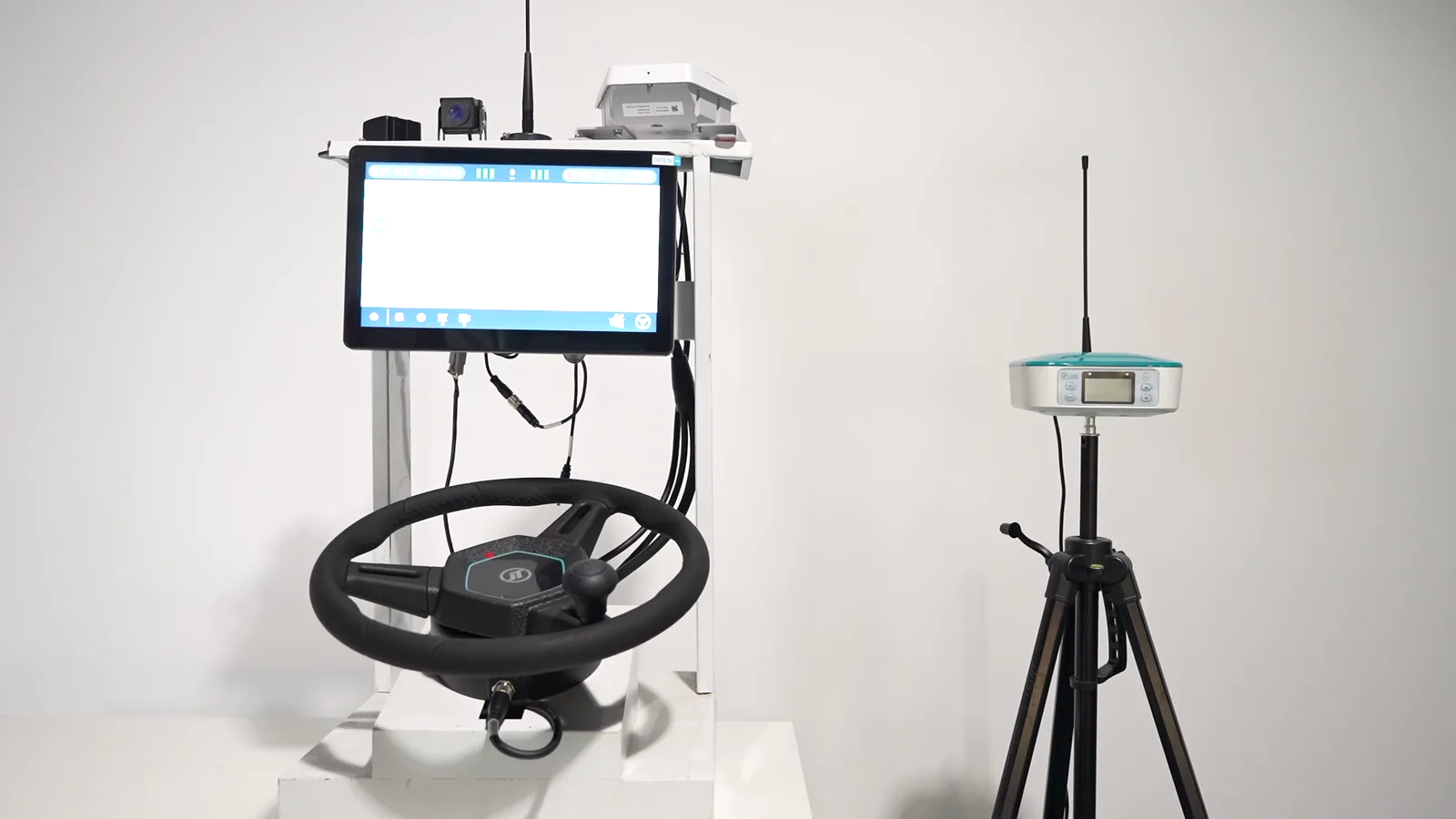
A receiver capable of tracking multiple GNSS constellations, and an interface. Entry-level kits pair a single- or dual-frequency receiver with a basic 7-inch display; package prices in this tier have fallen to USD 2,800–3,500 (source: IndexBox, 2026).
The receiver is where accuracy is set, and it is the component most often downgraded to hit a price. A receiver that tracks every open band at once holds a fixed solution through a partially blocked sky; one that does not will drop to a float solution under trees, and the line drifts with it. That difference never appears on a specification comparison until it costs you a planting pass.
Block 2 — Steering actuation
This is the block that decides whether a kit can be fitted to your tractor at all, and it is the main reason two quotes for "auto-steering" can differ by a factor of five.
The lightest option is an electric wheel motor that clamps onto the existing steering column — no hydraulic work, and it can be moved between machines. Hydraulic integration holds the line better at higher speeds and on heavy draft work, but requires tapping into the steering circuit, and on older tractors that alone can add GBP 3,000–8,000 to the installation (source: rtksub.com).
The extreme case is worth knowing because it explains a lot of confusing pricing. John Deere's ATU 300 steering unit lists at roughly USD 3,500–4,500 as a component — but it requires a John Deere display and a StarFire receiver to function, and a complete system built that way runs USD 15,000–20,000 (source: aboutagri.com, 2026). Same job, same field, several times the bill, because two expensive boxes came with it.
Block 3 — The correction signal
Raw GNSS positioning is metre-level. Corrections turn it into centimetres, and there are two ways to buy them, with very different cost curves.
A subscription to a network RTK service is the usual first choice where a CORS network exists. Published annual costs vary widely by region: USD 600–1,200 per vehicle in the APAC market survey (source: IndexBox, 2026), and €590 per year for 60 hours up to €2,000 per year unlimited on the Irish network, with casual use at €190 for 20 hours in a month (source: farmai.ie, 2026). The spread is not a pricing error; it reflects hours purchased and whether the service is delivered over cellular or satellite.
Your own base station eliminates the subscription. A portable receiver-and-radio base set up on a tripod or barn roof has been priced around USD 2,000 for budget brands (source: aboutagri.com, 2026), which is roughly two years of subscription — after which it is free, provided you are working within radio range of one farm. Purpose-built professional base infrastructure is a different order of magnitude entirely, at GBP 20,000–50,000, and only makes sense serving a fleet (source: rtksub.com).
There is a third route where no terrestrial network reaches at all. Satellite-delivered corrections — BeiDou B2b-PPP, Galileo HAS, or a commercial L-band service — need no base station and no cellular coverage. Their accuracy and availability are set by the service operator, and it is measured in decimetres, not centimetres. Choose that route for coverage, not for a centimetre figure it will not deliver. We cover this trade-off in detail in our guide to RTK where no CORS network exists.
Block 4 — Installation and calibration
Fitting the hardware is a day's work on a prepared machine. Calibration is what determines whether the centimetre figure on the brochure is what you get in the field: wheel-angle sensor calibration, antenna offset measurement, and a pass-to-pass check on the actual implement. Where a supplier quotes a system without an installation and commissioning line, that work has not been included — it has been moved onto you.
What the three price tiers actually buy
Published APAC market pricing tiers cleanly by specification:
| Tier | Typical hardware | 2026 price | Where it is the right answer |
|---|---|---|---|
| Entry — electric steering | Single-frequency GNSS receiver, steering actuator motor, ~7-inch display, 12 months standard cellular RTK | USD 2,800–3,500 | Broadacre spraying, tillage and spreading where pass-to-pass consistency matters more than absolute repeatability |
| Mid — hydraulic | Dual-frequency receiver, tilt compensation, ISOBUS implement control | USD 5,000–7,000 | Row-crop planting and strip-till, where the same line must be repeated next season |
| Premium — OEM-spec | Higher actuator torque, IP65 enclosures, multi-constellation boards with redundant IMUs | USD 8,000–15,000 | Tractors above 300 hp, contractors running mixed fleets |
(source: IndexBox, Asia-Pacific Agricultural RTK Auto Steering System Market, 2026)
The tier boundary that matters commercially is the first one. An entry system and a premium system produce the same straight line on open ground; they diverge on how the line survives terrain, how the system behaves at 20 km/h under load, and whether the implement can be controlled from the same screen. Buying premium hardware for flat spraying work is the most common way to overspend on this category.
Retrofit versus factory-fit: where the money differs
| Retrofit kit | Factory-fitted | |
|---|---|---|
| Cash cost | Visible and comparable | Bundled into machine price, rarely itemised |
| Eligible machines | Most tractors built after 2000 | Only when buying a new machine |
| Moving between machines | Possible, depending on mount | Locked to one machine |
| Hydraulic modification | Sometimes required on older machines | Not required |
| ISOBUS implement control | Depends on the kit — confirm before buying | Usually complete |
| Upgrade path | Hardware refresh is inexpensive | Tied to the machine's production cycle |
The comparison has one trap in it. Factory-fitted guidance has no comparable headline price, because every manufacturer bundles it differently — which is why the practical advice is to have the guidance specification itemised on any new-tractor quote, and then price that same specification as a retrofit. Without both numbers on paper, "included" and "cheaper" get confused (source: farmai.ie, 2026).
Retrofit has a second, quieter advantage that only shows up on mixed fleets. A system that moves between a planting tractor and a spraying tractor is doing work on two machines for one purchase. A factory-fitted unit only ever guides the machine it was sold with.
When it pays back: two answers, and why they differ
Auto-steering pays by deleting overlap. A manually steered machine typically re-covers 5–10% of the ground on passes, to guard against leaving skips — and that overlap is paid for twice over, in seed and chemical applied at a second full rate, and in the diesel and hours of a pass that was not needed (source: aboutagri.com, 2026; published overlap estimates commonly run 5–15%).
Worked at 500 acres with a 7% overlap reduction, the arithmetic looks like this:
| Input | Annual budget (500 acres) | Estimated saving at 7% |
|---|---|---|
| Seed | USD 45,000 | USD 3,150 |
| Fertiliser and chemicals | USD 50,000 | USD 3,500 |
| Fuel and labour | USD 15,000 | USD 1,050 |
| Total | — | USD 7,700 per year |
Against a USD 6,000 system, that is a payback inside one season (source: aboutagri.com ROI breakdown, 2026).
Now the same question asked by an independent research body. USDA Economic Research Service Report 217 found that GPS guidance on corn farms was associated with a 2.5% increase in operating profit and a 1.5% increase in net returns — not a double-digit yield gain (source: USDA Economic Research Service, Report 217).
Both sets of numbers are honest; they measure different things. The farm-level case study counts input not applied that would have been applied. The USDA analysis measures whole-farm profit, in which guidance is one input among many, and where its note explicitly records that studies reporting larger gains typically cover farms adopting several precision technologies together — guidance plus variable-rate application plus soil sensing — not guidance alone. If a supplier quotes you a 15% yield improvement from auto-steering by itself, ask which of those studies it came from.
On payback period, published figures diverge the same way:
- One to two years, from industry case data compiled across vendor examples, with an average saving around USD 15 per acre (source: AllyNav pricing and case data, 2026 — the source itself notes these are aggregated vendor cases, not controlled trials).
- Two to four years, from dealer-side service operations, with larger farms at 500+ hectares recovering faster through economies of scale (source: rtksub.com).
The disagreement is not arithmetical, it is about field geometry. Guidance pays by the straight metre. Short runs, awkward shapes, frequent headland turns and long road moves between blocks dilute the saving — which is exactly the situation on small fragmented farms. On large regular fields with real input spend, the one-to-two-year answer is plausible. On 6-hectare parcels with heavy headland work, the four-year answer is the safer assumption.
That gives two thresholds rather than one. On the lower end, a dealer-side assessment puts the economic floor at around 40 hectares of sprayed, spread or reseeded area per year — below that, hiring a contractor who already runs guidance usually beats buying (source: farmai.ie, 2026). On the upper end, 500+ hectares is where payback compresses sharply.
And overlaying both: if your market offers a capital grant on guidance equipment, run the calculation again with it applied. At a 40% grant rate the lower threshold moves down materially.
Our spray drone cost breakdown applies the same utilisation logic to aerial application, where the fixed-cost curve behaves the same way — low volume punishes ownership, and volume is the only thing that fixes it.
Real reference points: what the published numbers look like
Buyers researching this category shortlist from a recognisable group. These are published prices, not estimates.
| System | Type | Published price (2026) | Notes | Source |
|---|---|---|---|---|
| John Deere ATU 300 | Electric wheel motor | USD 3,500–4,500 unit only | Requires JD display + StarFire receiver; complete system USD 15,000–20,000 | aboutagri.com |
| FJDynamics AT2 | Electric wheel motor | USD 5,000–6,500 | No unlock or activation fees; needs an RTK signal source | aboutagri.com |
| AllyNav AF303 | Electric wheel motor | USD 4,500–6,000 | Entry positioning for tillage and spraying | aboutagri.com |
| AgOpenGPS (self-built) | DIY motor or hydraulic | USD 1,000–1,800 | Lowest cost; requires technical capability and support hunting | aboutagri.com |
| Portable RTK base station | Correction infrastructure | ~USD 2,000 | Removes the annual subscription within radio range | aboutagri.com |
| Trimble, Topcon, Ag Leader | Premium integrated | Not listed here | Dominate the premium integrated segment through software ecosystems and proprietary correction networks rather than hardware alone | IndexBox, 2026 |
One structural note that belongs on this page. Chinese GNSS manufacturers — CHC Navigation, ComNav Technology, Shanghai HuaCe Navigation — have moved from supplying components to selling complete systems, at estimated 30–45% below established international brands, and scale in the Yangtze River Delta and Pearl River Delta electronics clusters has compressed mid-range aftermarket gross margins by an estimated 8–14 percentage points since 2022 (source: IndexBox, 2026). That is the mechanism behind the price tiering in this article, and it is worth understanding before assuming a lower quote means lower specification.
Companies to consider
Buyers evaluating tractor auto-steering commonly compare the following suppliers:
1. JTILEP (Xuzhou Jitian Intelligent Equipment) — Xuzhou, China-based manufacturer of the HD818 retrofit auto-steering system (±2.5 cm RTK accuracy, HS-223A receiver tracking every open GNSS band, six correction sources including radio base, NTRIP, SBAS, BeiDou B2b-PPP and Galileo HAS, ISOBUS UT and TC-SC implement control, four guidance patterns, 0.1–25 km/h working range, MOQ 1) and the JT-80 spray and spread drone. OEM and ODM available for distributors and brand owners. Since 2008. 2. Trimble — the premium integrated reference; GFX and EZ-Steer lines, with its own correction network. Deepest software ecosystem for variable-rate and fleet data. 3. Topcon — X12 and Q-Guidance; strong in premium integrated and OEM specification. 4. John Deere — AutoTrac and the ATU 300 retrofit path; the most coherent choice if the fleet is already John Deere, the most expensive if it is not. 5. FJDynamics — electric-steering retrofit systems with a strong price-performance position and no activation fees. 6. AllyNav — entry-level electric-steering kits aimed at budget-conscious tillage and spraying operations.
All figures are third-party published data. Specifications for competing systems should be verified against each manufacturer's current documentation before purchase.
Why Xuzhou, China matters for auto-steering buyers
Xuzhou sits in Jiangsu Province, inside the Yangtze River Delta manufacturing belt — the industrial cluster that the market analysis above identifies as the source of the price compression in this category, alongside the Pearl River Delta electronics hubs.
Three consequences matter to a buyer. Cost structure: the receiver boards and electric drive components come from the same regional supply base that supplies international brands, which is what makes a 30–45% price gap possible without a corresponding specification gap. Spare parts: sensors, motors and displays are standard industrial components rather than proprietary assemblies, so they remain available through the life of the machine. Configuration flexibility: a line set up for configuration variance, rather than a single fixed model, is why an MOQ of one unit is workable at all.
The question worth asking any supplier is not where the box was assembled. It is whether they can tell you which correction sources the receiver actually supports, whether the kit is Steer-Ready on your machine or needs hydraulic work, and what happens to the guidance line at 25 km/h on a slope. Those are answerable questions. Ask them before you compare prices.
Auto-steering is one layer of a precision navigation stack — section control and variable-rate application build on the same positioning, and neither works if the line underneath is inconsistent.
How to get a quote
Every system is quoted per configuration, because the right kit depends on your tractor, your implement control requirements and how you intend to get corrections. Pricing is confirmed on the proforma invoice and contract.
To get an accurate quotation on the first attempt, send us:
- Tractor make, model and year — determines the mounting option and whether hydraulic work is needed
- Whether the machine is Steer-Ready from the factory
- Primary operation: planting, spraying, spreading, tillage, or a mix
- Total hectares per season under guidance, and typical field size and shape
- Correction plan: existing NTRIP or CORS service, your own base station, or satellite corrections
- Implement control need: none, or ISOBUS section control for specific implements
- Terrain: flat, sloping, terraced, or mixed
- OEM/ODM interest, if you are a distributor or brand owner
Contact: sandy@jtilep.com · WhatsApp +86 18361249936
Frequently asked questions
How much does it cost to retrofit auto-steering in 2026?
An entry-level electric-steering kit runs USD 2,800–3,500, and a mid-range hydraulic kit with dual-frequency correction and ISOBUS implement control USD 5,000–7,000 (source: IndexBox, 2026). Add USD 600–1,200 per vehicle per year for RTK corrections unless you run your own base station. Total retrofit projects are quoted from USD 2,500 to USD 13,000 depending on tier and whether hydraulic modification is required (source: AllyNav dealer pricing, 2026).
Is retrofit cheaper than factory-fitted auto-steering?
Usually — but the comparison is rarely made fairly. Factory-fitted guidance is bundled into the machine price and each brand bundles it differently, so the only valid method is to have the guidance specification itemised on the new-tractor quote and price the same specification as a retrofit (source: farmai.ie, 2026). Retrofit also has the advantage of being movable between machines.
Will auto-steering really cut my input costs by 15%?
Not by 15% across the board, and not according to the most authoritative source. Industry case data reports reductions of 15–30% in fertiliser, 10–20% in pesticide and 8–15% in fuel, averaging around USD 15 per acre saved (source: AllyNav, 2026 — aggregated vendor cases, not controlled trials). USDA Economic Research Service Report 217, measuring whole-farm outcomes, found a 2.5% increase in operating profit and 1.5% in net returns on corn farms. Treat the first set as an upper planning bound and the second as the conservative whole-farm case.
How many hectares before auto-steering pays for itself?
Two published thresholds bracket the answer: around 40 hectares per year of sprayed, spread or reseeded area is the dealer-side economic floor, below which hiring a contractor with guidance already fitted tends to win; and 500+ hectares is where payback compresses sharply through scale (source: farmai.ie, 2026; rtksub.com). Reported payback periods run from one to two years on vendor case data to two to four years on dealer-side estimates.
Do I need an RTK subscription, or can I install my own base station?
A subscription is simpler and cheaper to start, at USD 600–1,200 per vehicle per year (source: IndexBox, 2026). A portable base station runs about USD 2,000 and removes the recurring fee outright within its radio range (source: aboutagri.com, 2026) — typically one farm. If your fields sit beyond any terrestrial network, satellite-delivered corrections are the remaining option, at decimetre accuracy rather than centimetre.
What accuracy do I need for different operations?
RTK, at centimetre level, is the requirement for planting, strip-till and controlled traffic, where the same line must be repeated season after season. For spraying, spreading and general tillage, correction tiers below RTK are frequently adequate, and buying more accuracy than the operation needs is a common source of wasted budget (source: farmonaut.com, 2026).
Can JTILEP supply auto-steering systems for OEM or our own brand?
Yes. Colour and logo OEM/ODM are available for distributors and brand owners, with an MOQ of one unit for standard configurations. The HD818 supports six correction sources and ISOBUS UT and TC-SC implement control, which is what most OEM discussions turn on. Send your target specification and market — see our OEM and B2B terms for the process.
Conclusion
The price of retrofitting auto-steering is no longer the hard part of this decision. An entry kit at USD 2,800–3,500, or a hydraulic mid-tier at USD 5,000–7,000, is well documented and widely available. What separates a good purchase from a poor one is whether the system actually fits your machine and your correction situation, and whether your hectares are the shape that guidance pays on.
Three things to settle before signing. Get the guidance specification itemised — on the retrofit quote and on any new-tractor quote, so the two can be compared like for like. Decide your correction route deliberately, because the annual fee is the cost that never appears in the headline price. And check whether your market grants capital support for guidance equipment, since a 40% grant changes the payback period more than any hardware discount will.
JTILEP manufactures the HD818 auto-steering system and the JT-80 spray drone in Xuzhou, China, and exports B2B with OEM/ODM terms and MOQ 1. If you would like the payback calculation run against your own hectares, current input spend and machine, send us the details and we will work through it with you.
Retrofitting auto-steering on your fleet?
The HD818 retrofits onto tractors you already own, with multi-source correction support so the same kit works where CORS is dense and where it is not. Tell us your machine models and working width and we will quote the kit for your machines.