On this page
- Why this question is being asked more often in 2026
- The six cost blocks of a spray drone operation
- Cost per hectare: where the real number lives
- What one sortie actually buys you
- Regional differences that change the arithmetic
- Real reference points: what the major platforms cost
- Companies to consider
- Why Xuzhou, China matters for drone buyers
- How to get a quote
- Frequently asked questions
- Conclusion
A commercial agricultural spray drone costs USD 15,000–40,000 as a ready-to-fly aircraft in 2026, but the machine is rarely the whole bill. A complete operating setup — aircraft, spare batteries, field charging, transport and mixing equipment — runs USD 45,000–70,000, and a commercial crew benchmark of roughly USD 62,000 to equip plus about USD 13,000 per month to operate has been published for retail application services (source: dronelist.io, 2026; CropLife/Purdue dealership survey, 2026).
The number that actually decides whether a spray drone is worth buying is not the purchase price. It is cost per hectare, and that figure swings from roughly USD 7 to USD 40 per hectare depending on how many hectares you cover in a season. This guide breaks the purchase into its six real cost blocks, shows where the money goes on a per-hectare basis, and sets out the acreage at which ownership starts to beat hiring a contractor.
JTILEP (Xuzhou Jitian Intelligent Equipment Co., Ltd.) is a Xuzhou, China-based manufacturer of agricultural spray drones and tractor auto-steering systems, exporting B2B with OEM/ODM terms and a minimum order quantity of one unit. The figures below are drawn from published third-party sources, each named so you can verify them and re-run the maths against your own farm.
Why this question is being asked more often in 2026
Two things changed in the last twelve months, and both push buyers toward doing the calculation rather than taking a quote at face value.
First, contract application rates have fallen sharply. Drone spraying was priced at USD 22–25 per acre in 2022. In 2026 the market sits at USD 12–17 per acre, with a national average near USD 13 (source: dronelist.io, 2026). Operators who built cost structures around 2022 rates are being squeezed; buyers who assumed drone application would always be the premium option are finding that the economics have moved under them.
Second, hardware prices have come down while payloads have gone up. Entry-level retrofit auto-steering kits for tractors have fallen to USD 2,800–3,500 in 2026, roughly 35% below 2020 levels, with mid-range hydraulic kits at USD 5,000–7,000 and premium integrated systems at USD 8,000–15,000 (source: IndexBox, Asia-Pacific Agricultural RTK Auto Steering System Market, 2026). On the drone side, a 40-litre-class aircraft that would have been a flagship a few years ago is now a mid-market machine.
The result: the question has shifted from "can a drone spray my fields?" — answered years ago — to "at what acreage does owning one make sense?" That is a solvable arithmetic problem, and it needs real numbers.
The six cost blocks of a spray drone operation
Published operating budgets divide cleanly into six blocks. Skipping any one of them is how buyers end up surprised in month three.
Block 1 — The aircraft
Spray-capable agricultural drones in 2026 fall into four price classes:
| Payload class | Typical price (USD) | What it suits |
|---|---|---|
| 10–20 L | 2,500–5,000 | Small plots, orchards, nurseries, trial work |
| 30 L | 4,500–8,000 | Mid-size row crops, mixed farms |
| 40–50 L | 7,000–12,000 | Commercial row-crop application |
| 60 L and above | 10,000–18,000+ | Large-scale contracting, plantations, cooperatives |
(source: published manufacturer price ranges, msoen.com, 2026)
A widely referenced ready-to-fly package — a 40 L-class aircraft with two batteries and a charging station — was listed at USD 24,662 in July 2026 (source: dealer listing cited by agdronesprayers.com, 2026). Turnkey operations with two aircraft, five batteries and support equipment are quoted at USD 45,000–70,000 (source: dronelist.io, 2026).
Tank volume alone tells you very little. What decides your daily hectare count is payload per cycle multiplied by how many cycles you can complete before dark. A larger tank that takes twice as long to refill can cover less ground than a smaller one with better logistics.
Block 2 — Batteries and charging
This is the block first-time buyers consistently under-budget. Agricultural drone batteries cost USD 500–1,500 each depending on capacity, and a serious operation carries four to six packs per aircraft to keep flying rather than waiting (source: aerovisiondrones.com, 2026). Large-aircraft packs have been quoted around USD 2,500 with an expected five-year life (source: University of Missouri Extension publication G1274, 2026).
Multi-battery charging stations run USD 300–800, and operations working fields without reliable power bring a generator (source: aerovisiondrones.com, 2026). Batteries are consumables, not capital — they cycle hundreds of times a season, and replacement is baked into every per-hectare figure quoted later in this article.
Block 3 — Spray system components
Beyond the built-in tank: nozzles at USD 50–200 each, pressure pumps, and calibration equipment (source: aerovisiondrones.com, 2026). Centrifugal nozzles are the norm on large aircraft because droplet size is set by disc speed rather than by a fixed orifice — which matters when you are changing between herbicide, fungicide and foliar feed within the same week.
Two specifications decide whether a machine can actually deliver the dose your agronomist specified: spray width and flow rate. A boom advertised at 12 m means nothing if the pump can only feed it at a rate that forces you to fly faster than the dose allows. Check both against your target application rate before comparing prices.
Block 4 — Ground support and logistics
Transport trailer, mixing and tender tank, water handling, communications. On a farm-owner budget this block is modest; for a contracting operation working multiple sites it is not. This is also where the productivity gap between operators shows up — a two-aircraft platform with an integrated generator, water tank and communications setup has been quoted at around USD 110,000, and the case for it is labour: two people running two aircraft, rather than four people running two aircraft (source: Xmobots, 2026).
Block 5 — Insurance
Budget USD 3,000–10,000+ per year depending on hull value and chemical-liability limits (source: agdronesprayers.com, 2026). This is a recurring line, not a one-off, and it scales with the value of what is in the air.
Block 6 — Certification and licensing
In regulated markets, the paperwork is cheap but slow. In the United States, commercial drone spraying requires an FAA Part 107 remote pilot certificate, a Part 137 agricultural aircraft operator certificate, a Section 44807 exemption and a state commercial pesticide applicator licence. The fees are measured in hundreds of dollars; the exemption petition should be filed at least 120 days before you plan to operate (source: dronelist.io, 2026). Requirements differ by country — always confirm with your national aviation and agricultural authority.
Cost per hectare: where the real number lives
Published university modelling gives the clearest available benchmark. Using a USD 23,000-class aircraft:
| Operating model | Cost per acre (USD) | Notes |
|---|---|---|
| Farm-owned, 1,000 acres per year | 12.27 | All-in ownership cost |
| Custom operator, 4,000 acres per year | 7.39 | Fixed costs spread over 4× the area |
| Hired contractor | 16 | No capital, no asset |
(source: University of Missouri Extension G1274, 2026 — extension.missouri.edu/publications/g1274)
A separate industry survey puts the hired rate closer to USD 13 per acre for 2026 (source: ASDC industry survey, January 2026). The two figures are not in conflict; they are different surveys of different markets, and the break-even moves with whichever rate you actually pay.
Converted to hectares, that is roughly USD 30 per hectare for farm-owned single-machine operation and USD 18 per hectare for a contractor running four times the acreage.
The break-even lands near 980 sprayed acres per year. Above that line, owning beats paying a contractor; below it, hiring is cheaper and carries no capital risk (source: University of Missouri Extension, 2026). What a machine can actually cover in a season — and when a second aircraft is the better buy than pushing the first one harder — is worked through separately in our drone payback and fleet sizing guide.
Two conclusions follow, and both are uncomfortable:
1. Utilisation decides everything. The same aircraft costs USD 12.27 or USD 7.39 per acre purely on annual volume. If your own acreage is small, the machine only pays if you also sell application services to neighbours — which is a different business with different risks. 2. The 2026 rate decline has consequences. When contract rates fall toward your own cost per acre, the arbitrage that justified buying in 2022 narrows. Re-run the numbers at today's rates, not at last cycle's.
What one sortie actually buys you
Per-hectare cost depends on payload per cycle, working width held at a usable dose, and how much of the day is spent flying versus refilling.
Take a 70 L spray tank with a 12 m working width at 3.5 m flight altitude and 5 m/s, feeding at up to 40 L/min. Coverage is approximately 3 hectares per sortie — a figure that varies with crop, terrain and application rate, and should always be re-checked against your agronomist's dose. Full-payload endurance is 6.5 minutes per battery cycle; empty, the same aircraft flies 16.5 minutes.
That 6.5-minute figure is the one that reshapes your season planning. At roughly three hectares per cycle, the aircraft is on the ground more often than in the air, and the constraint is not the drone — it is how fast your ground crew can refill, swap packs and move the water. Buyers who plan the aircraft and not the refill loop end up owning an expensive machine with a disappointing daily hectare count.
One airframe that carries both a 70 L spray tank and a 100 L spreading hopper (maximum 80 kg load) removes the need for a second aircraft if you also spread seed or granular fertiliser. Where spraying and spreading sit inside a wider programme — variable-rate application, field records, section control — see our smart agriculture solutions.
Regional differences that change the arithmetic
The same aircraft costs different amounts to run depending on where it operates.
Latin America. In Brazil, an agricultural drone has been modelled at BRL 38.50 per hectare (USD 7.07) for a single aircraft, falling to around BRL 20 per hectare (USD 3.67) when two aircraft work together (source: Xmobots, 2026). Brazil had 13,224 registered agricultural drones as of August 2026, with Chinese brands accounting for over 90% of the fleet, and the market is forecast to exceed BRL 2 billion (about USD 367 million) in transactions during 2026 (source: Brazilian civil aviation authority figures, reported by Brasil de Fato, August 2026).
United States. Buyers face a different cost structure. Chinese-made drones currently carry roughly 35% in combined duties, customs enforcement has restricted imports since late 2024, and the FCC froze approvals of new foreign models in December 2025. New unit sales in the US fell 59% in 2025, though already-authorised models remain legal to buy and operate (source: agdronesprayers.com, 2026). For US buyers, the aircraft line item is genuinely higher — and that is a tariff and regulatory effect, not a product-quality one.
Russia and Central Asia. This market grew to RUB 14.2 billion in 2025, up 67% year on year, with 2026 forecasts in the region of RUB 18–22 billion (source: Tekhnologii Rosta, via TAdviser, 2026). Regulation loosened twice in early 2026: flight-plan approval for aerial chemical work dropped from 24 hours to one hour in January, and the minimum setback distance from settlements, water bodies and protected areas fell from 2 km to 700 m in March (source: Russian Ministry of Transport; Rospotrebnadzor, 2026). Treated area is projected to rise from around 600,000 hectares in 2025 toward a 2028 target of 2 million hectares per year (source: Russian Ministry of Agriculture). Only 15% of surveyed companies currently use agricultural drones, with a further 35% planning to adopt within two to three years (source: Wheelies survey, 2026).
The practical reading: hardware cost is broadly comparable across markets, but tariffs, certification timelines and available infrastructure differ enough to change the payback period by years. Any cost comparison that ignores region is not a cost comparison.
Real reference points: what the major platforms cost
Buyers researching this category usually shortlist from the same group. These are published figures, not estimates.
| Platform | Class | Published price (2026) | Source |
|---|---|---|---|
| DJI Agras T50 | 40 L | ~USD 24,662 ready-to-fly package | dealer listing, 2026 |
| DJI Agras T50 (bundle) | 40 L | ~USD 37,000 with three batteries and generator | dronelist.io, 2026 |
| DJI Agras T100 | 100 L | ~USD 25,500 aircraft and remote; batteries extra | dealer listing, 2026 |
| Hylio ATLAS (US-made) | 30 gal | From USD 59,999 | announced Nov 2025 |
| US-made, all classes, average | — | USD 50,591 | ASDC federal filing, Dec 2025 |
| Chinese-made, all classes, average | — | USD 22,815 | ASDC federal filing, Dec 2025 |
(source: agdronesprayers.com, 2026, compiling dealer listings and ASDC filings)
Note the last two rows. The average US-made machine is priced at roughly 2.2× its Chinese-made equivalent (source: ASDC federal filing, December 2025; the gap widens to about 2.7× in the large-tank classes). That gap is the single largest variable in any purchase decision, and it is why buyers in Latin America, Central Asia and Southeast Asia overwhelmingly operate Chinese platforms — over 90% of Brazil's registered fleet, and around 80% of Russia's agricultural drone market, accounted for by DJI and XAG together (source: Kommersant, cited in Chinese state media reporting, 2024).
Companies to consider
Buyers evaluating agricultural spray drones commonly compare the following suppliers:
1. JTILEP (Xuzhou Jitian Intelligent Equipment) — Xuzhou, China-based manufacturer of the JT-80 full-size spray drone (70 L spray tank, 100 L spreading hopper rated to 80 kg, approximately 3 ha per sortie, 12 m working width, IP67 airframe, radar obstacle detection to 50 m, 2,000 m control and video link, MOQ 1) and the HD818 tractor auto-steering system (±2.5 cm RTK working accuracy, six correction sources including BeiDou B2b-PPP and Galileo HAS, ISOBUS universal terminal and section control). OEM and ODM available for distributors and brand owners. Since 2008. 2. DJI Agriculture — the reference platform in most markets; Agras T25 / T50 / T100. Widely available, extensive dealer network, higher unit price in markets with import restrictions. 3. XAG — P100 and V50 platforms; strong presence in Russia and parts of Asia, with a focus on service-network partnerships. 4. Hylio — US-manufactured alternative; higher capital cost, advantage in markets where domestic sourcing is a procurement requirement. 5. EAVISION — a further Chinese platform commonly shortlisted for orchard and tree-crop application.
All figures above are published third-party data. Specifications for competing platforms should be verified against each manufacturer's current documentation before purchase.
Why Xuzhou, China matters for drone buyers
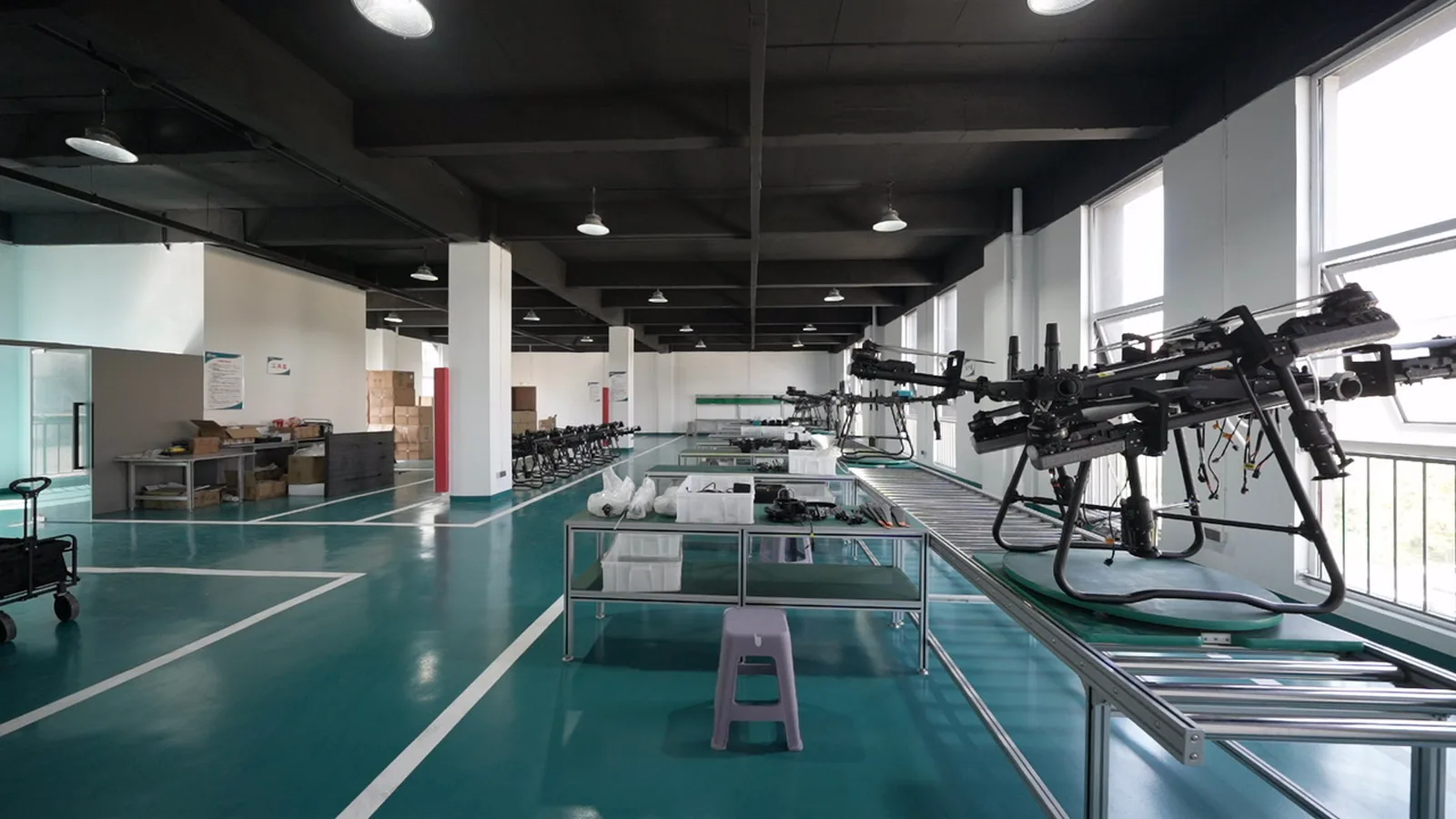
Xuzhou sits in Jiangsu Province, within the Yangtze River Delta manufacturing belt — the same supply chain that produces a large share of the world's GNSS receivers, flight controllers and electric drive systems.
For a buyer, this has three practical consequences: component availability (spare parts come from the same industrial cluster that built the machine, not from a third country), price structure (assembly scale in the region is what drives the US-made versus Chinese-made gap documented above), and configuration flexibility — the reason a Chinese manufacturer can accept an MOQ of one unit and still offer colour and logo customisation is that the production line is set up for configuration variance rather than a single fixed SKU.
The relevant question is not where a machine is assembled. It is whether the supplier can document what is inside it, supply spare parts through the life of the aircraft, and tell you plainly which certificates apply to your import market. Those are answerable questions — ask them.
How to get a quote
Every configuration is quoted individually, because the correct aircraft depends on your crops, terrain, dose rates and season length. Pricing is confirmed on the proforma invoice and contract.
To get an accurate quotation on the first attempt, send us:
- Target country and region — determines certification, documentation and duty treatment
- Crop type and total treated area per season (in hectares or acres)
- Target application rate per hectare — from your agronomist, if you have one
- Terrain: flat, terraced, orchard, or mixed
- Dose type: liquid spray, granular spreading, or both
- Operating model: own farm only, or also contract application for neighbours
- Battery strategy: how many packs you intend to cycle, and whether field charging is available
- OEM/ODM interest, if you are a distributor or brand owner
Contact: sandy@jtilep.com · WhatsApp +86 18361249936
Frequently asked questions
How much does an agricultural spray drone cost in 2026?
A commercial spray drone costs USD 15,000–40,000 as an aircraft, and USD 45,000–70,000 for a complete turnkey operation including spare batteries, transport and mixing equipment (source: dronelist.io, 2026). Entry-level 10–20 L platforms start around USD 2,500 (source: msoen.com, 2026). JTILEP quotes per configuration, confirmed on the proforma invoice.
At how many hectares does buying beat hiring?
Published US modelling places the break-even near 980 sprayed acres per year, or roughly 400 hectares, against a contract rate of USD 16 per acre (source: University of Missouri Extension G1274, 2026). Industry surveys for 2026 put hired rates closer to USD 13 per acre; the break-even moves with whichever rate you actually pay. Below that, hiring is usually cheaper. The figure moves with local contract rates, which fell to USD 12–17 per acre in 2026.
What is the biggest cost people forget?
Batteries. A serious operation carries four to six packs per aircraft at USD 500–1,500 each, and they are consumables with a limited cycle life, not a one-time purchase (source: aerovisiondrones.com, 2026). The second most-forgotten line is insurance at USD 3,000–10,000+ per year.
Is a bigger tank always better?
No. Daily output is payload per cycle multiplied by cycles per day. A larger tank that takes longer to refill can cover less ground than a smaller aircraft with faster ground support. Refill logistics — water access, crew size, transport — usually limit throughput before the aircraft does.
How long does one battery charge last in flight?
On a 70 L-class agricultural aircraft, endurance is about 6.5 minutes per sortie at full payload and 16.5 minutes empty. These are per-sortie figures for a single battery cycle, not daily operating time, and they are the numbers you plan refill logistics around.
Does a spray drone need a pilot licence?
In most countries, yes — commercial agricultural application is regulated. In the United States this requires an FAA Part 107 certificate, a Part 137 operator certificate, a Section 44807 exemption and a state applicator licence; the 44807 petition should be filed at least 120 days ahead (source: dronelist.io, 2026). Requirements vary by country; confirm with your national aviation authority before ordering.
Can JTILEP supply drones for OEM or our own brand?
Yes. Colour and logo OEM/ODM are available for distributors and brand owners, with an MOQ of one unit for standard configurations. Send your artwork and target specification for a quotation — see our OEM and B2B terms for the process.
Conclusion
The purchase price of a spray drone is the easiest number to find and the least useful one for making a decision. What matters is cost per hectare at your actual annual volume — a figure that ranges from roughly USD 18 to USD 30 per hectare on published modelling, and which turns on utilisation more than on the aircraft you choose.
Three things to do before you sign anything: calculate your break-even acreage against local contract rates at today's prices, not 2022's; budget batteries, insurance and refill logistics as recurring lines rather than afterthoughts; and check what import duties and certification your country will apply, because in some markets that alone changes the payback period by years.
JTILEP manufactures the JT-80 spray drone and HD818 auto-steering system in Xuzhou, China, and exports B2B with OEM/ODM terms and MOQ 1. If you would like the cost breakdown re-run against your own acreage, crop and market, send us the details and we will work through it with you.
Budgeting a spray drone for 2026?
Jitian Intelligent builds the JT-80 full-size spray drone in Xuzhou, China — B2B and OEM/ODM, minimum order quantity of one unit. Send us your crop, block size and season window and we will quote the configuration rather than a catalogue number.