On this page
- Why the comparison is being redrawn in 2026
- Three methods, three cost structures — and why most comparisons are wrong
- Cost per hectare, one source, one definition
- Cost per acre under ownership
- What the cost tables leave out: access and timeliness
- Where each method actually wins
- The variables that flip the ranking
- Companies to consider
- Why Xuzhou, China matters for this comparison
- How to get a quote
- Frequently asked questions
- Conclusion
On the clearest like-for-like benchmark available — one source, one country, one cost definition — a single agricultural drone costs more per hectare than a self-propelled ground sprayer. Modelling for Brazil puts a one-aircraft drone operation at BRL 38.50 per hectare at 28 ha/h, against BRL 31.50 for a self-propelled sprayer at 55 ha/h and BRL 27 for an agricultural aircraft at 100 ha/h. Pair two drones and the figure falls to about BRL 20 per hectare at 70–75 ha/h (source: Xmobots, 2026).
That ranking surprises people, and it should be read carefully rather than quoted alone. Per-hectare cost is not what decides between these three methods. Access and timeliness are. A ground sprayer that cannot enter a field after rain, or a fixed-wing aircraft that cannot safely work a terraced block, has no cost per hectare at all — it has an availability of zero.
This guide sets out the cost structure of each method on a comparable basis, then shows the conditions under which the ranking actually flips.
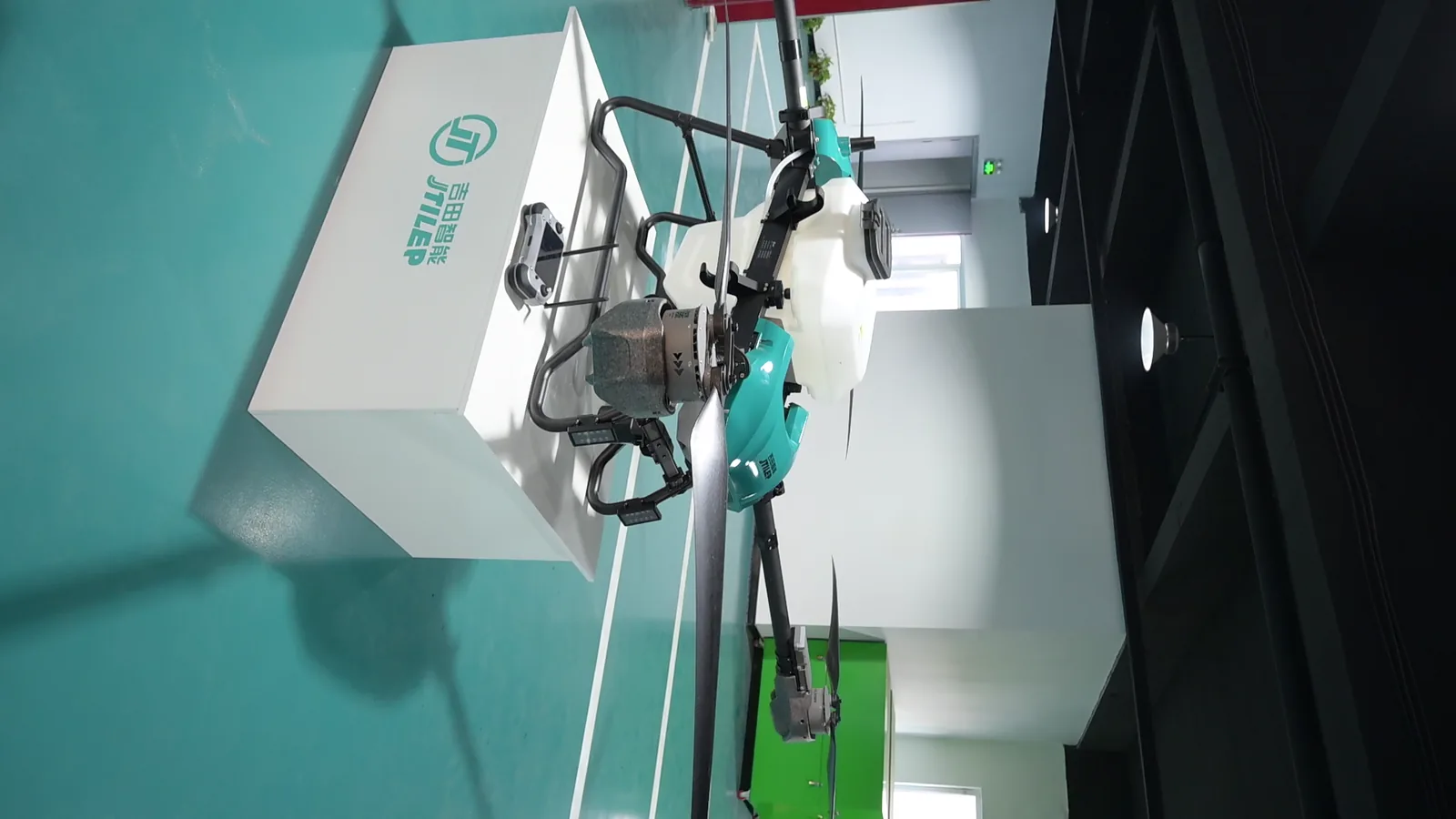
JTILEP (Xuzhou Jitian Intelligent Equipment Co., Ltd.) is a Xuzhou, China-based manufacturer of agricultural spray drones and tractor auto-steering systems, exporting B2B with OEM/ODM terms and a minimum order quantity of one unit. All third-party figures are named, and the two cost benchmarks below are kept in separate tables because they use different definitions — which is the single most common error in this comparison.
Why the comparison is being redrawn in 2026
Three things moved at once.
Contract rates fell. Drone application was priced at USD 22–25 per acre in 2022; by 2026 the market sits at USD 12–17 per acre with a national US average near USD 13 (source: dronelist.io, 2026). Any comparison written before that shift is out of date. The six cost blocks behind those rates are itemised in our spray drone cost breakdown.
Aircraft cost fell with volume. A 40-litre-class aircraft that would have been a flagship a few years ago is now a mid-market machine, and turnkey operations are quoted at USD 45,000–70,000 with the aircraft alone at USD 15,000–40,000 (source: dronelist.io, 2026).
Fleets became large enough to farm the data. Brazil alone had 13,224 registered agricultural drones as of August 2026, with Chinese brands accounting for over 90% of the fleet, and the market expected to exceed BRL 2 billion in transactions during 2026 (source: Brazilian civil aviation authority figures, reported by Brasil de Fato, August 2026). At that scale, drone application stops being a novelty line item and starts being compared on the same sheet as sprayers and aircraft.
Three methods, three cost structures — and why most comparisons are wrong
Before any table, the definitions have to be separated, because the published benchmarks for these methods are not measuring the same thing.
Application cost measures what it costs to get a hectare sprayed: fuel or battery, chemical, labour, and the depreciation of the machine over its working hours. It is what a contractor charges, or what an owner's marginal cost looks like once the machine is bought.
Ownership cost measures the total annual burden of owning the equipment: purchase price amortised, insurance, storage, training, certification, and the fixed costs that accrue whether or not the machine works. It is the number that produces the familiar "it depends how many acres you cover" answer.
A benchmark quoted in application cost will almost always look cheaper than one quoted in ownership cost, for the same machine. Comparing a Brazilian application-cost figure against a US ownership-cost figure — which is what happens whenever these numbers are put in one table — produces a gap that reflects accounting, not agronomy.
So this guide uses two tables, each internally consistent.
Cost per hectare, one source, one definition
Brazil, contractor-side application cost, single and paired aircraft:
| Method | Working rate | Cost per hectare | Cost per acre (approx.) |
|---|---|---|---|
| Drone, single aircraft | 28 ha/h | BRL 38.50 (≈ USD 7.07) | ≈ USD 2.86 |
| Drone, two aircraft paired | 70–75 ha/h | BRL 20 (≈ USD 3.67) | ≈ USD 1.49 |
| Self-propelled ground sprayer | 55 ha/h | BRL 31.50 (≈ USD 5.79) | ≈ USD 2.34 |
| Agricultural aircraft | 100 ha/h | BRL 27 (≈ USD 4.96) | ≈ USD 2.01 |
(source: Xmobots, 2026; conversions at the rate used in that modelling)
Read that table in the right order and the drone case is clear. A single drone is the most expensive way on this list to cover a hectare, and a paired drone is the cheapest by a wide margin. The gap is not about the aircraft; it is about whether the crew and the ground support are fully occupied. One aircraft leaves a crew waiting on the refill cycle. Two aircraft, sharing one water source, generator and operator team, roughly halve the per-hectare burden.
Note also the working rates. The drone is the slowest method per machine-hour and the aircraft is the fastest by nearly four times. Where the spraying window is short, hourly throughput decides outcomes that cost per hectare cannot capture.
Cost per acre under ownership
United States, farm-owned and hired, ownership cost for a USD 23,000-class aircraft:
| Operating model | Cost per acre | Cost per hectare (approx.) |
|---|---|---|
| Farm-owned drone, 1,000 acres/yr | USD 12.27 | ≈ USD 30.30 |
| Custom operator drone, 4,000 acres/yr | USD 7.39 | ≈ USD 18.26 |
| Hired drone contractor | USD 16 | ≈ USD 39.50 |
(source: University of Missouri Extension publication G1274, 2026 — extension.missouri.edu/publications/g1274)
These two tables are not comparable with each other, and the reason is worth understanding rather than working around. The Brazilian figures measure the cost of applying a hectare by a service operator, where the capital is already sunk and spread over a large annual volume. The US figures measure what a farm carries to own and run the equipment over its own acreage — including the fixed costs that a 400-acre farm cannot escape.
The apparent four-fold gap between them is mostly the difference between a machine working thousands of hectares a year and a machine working a few hundred. It is the same lesson that governs the buy-versus-hire decision, and it is why a drone can be the most expensive option on one farm and the cheapest on the next.
What the cost tables leave out: access and timeliness
Cost per hectare assumes the machine can do the job. For all three methods, that assumption breaks in specific conditions.
| Condition | Ground sprayer | Agricultural aircraft | Spray drone |
|---|---|---|---|
| Soil too wet after rain | Cannot enter — soil damage | Works | Works |
| Tall crop, late season (maize, sugarcane) | Crop damage, boom height limit | Works | Works |
| Terraced, sloping or small irregular blocks | Limited | Often unsafe or uneconomic | Works |
| Large flat blocks, high daily area | Strongest | Strongest | Slower per machine |
| Buffer zones, water bodies, residential proximity | Constrained by sprayer width and drift | Constrained by swath and speed | Lower volume per pass; setback rules vary by country |
| Nocturnal application | Possible with lighting | Restricted in many jurisdictions | Common practice in several markets |
The pattern is consistent: the drone's advantage is concentrated in the conditions where the other two cannot operate. Late-season maize that a ground sprayer would flatten, a paddy block with no firm access, a terraced orchard, a field that received rain 30 hours ago — these are where drone application earns a premium that per-hectare cost tables do not show.
The corollary is equally important. On large, flat, dry blocks with road access, the ground sprayer is usually the right machine, and it is not close on cost. A drone programme on that kind of farm is paying for capability it will not use.
Where each method actually wins
| Situation | Recommended method | Why |
|---|---|---|
| Large flat blocks, dry conditions, road access | Self-propelled ground sprayer | Lowest cost per hectare at high daily throughput |
| Very large continuous areas, rapid turnaround needed | Agricultural aircraft | Highest hourly throughput where landing strips and site conditions allow |
| Late-season tall crops, wet soils, terraces, small parcels | Spray drone | Access where the alternatives cannot enter |
| Mixed farm with a mix of the above | Drone as the access solution, ground sprayer for the bulk area | Match machine to block rather than replacing one method wholesale |
| Emergency response to a fast-moving disease or pest | Drone or aircraft | Timeliness over cost per hectare |
That final row deserves emphasis. Agricultural application decisions in outbreak conditions are made on days, not on dollars per hectare. A method that arrives in 36 hours at a higher cost per hectare is worth more than a cheaper method that arrives in two weeks.
The variables that flip the ranking
Four factors move this comparison more than any hardware specification.
Annual volume. Between 1,000 and 4,000 acres, published modelling takes the same aircraft class from USD 12.27 to USD 7.39 per acre — a 40% swing from volume alone (source: University of Missouri Extension G1274, 2026). At low volumes, the drone loses to almost everything. At high volumes with paired aircraft, it wins the Brazilian comparison outright. The acreage at which ownership overtakes hiring, and how to size a fleet once it does, is worked through in our payback and fleet sizing guide.
Pairing. The single most consequential operating decision in the Brazilian benchmark is running two aircraft instead of one: BRL 38.50 to BRL 20 per hectare, driven by shared ground support rather than by the aircraft (source: Xmobots, 2026). A single-aircraft operation compares badly against every alternative.
Block geometry. Drones and guidance both pay by the straight metre. Small parcels, long road moves and heavy headland work dilute the productivity that any cost table assumes.
Labour and regulation. Where seasonal agricultural labour is expensive or unavailable, the labour profile of a two-person drone crew compares favourably with a sprayer plus operator plus support. Where aerial application is tightly regulated — or effectively unavailable — the aircraft column disappears from the table entirely, regardless of its cost.
Companies to consider
Buyers evaluating agricultural spray drones commonly compare the following suppliers:
1. JTILEP (Xuzhou Jitian Intelligent Equipment) — Xuzhou, China-based manufacturer of the JT-80 spray and spread drone (70 L spray tank, 100 L spreading hopper rated to 80 kg, 12 m spray width, approximately 3 ha per sortie, 6.5 minutes at full payload, 2,000 m control and video link, IP67 airframe, radar obstacle detection to 50 m, multi-aircraft coordination for paired operation, MOQ 1) and the HD818 tractor auto-steering system. OEM and ODM available for distributors and brand owners. Since 2008. 2. DJI Agriculture — the reference platform in most markets; Agras T25 / T50 / T100, with the widest dealer and service network. 3. XAG — P100 and V50 platforms, with a service-network model in several regions and an established position in Russia and parts of Asia. 4. Hylio — US-manufactured alternative; higher capital cost, relevant where domestic sourcing is a procurement requirement. 5. EAVISION — a further Chinese platform commonly shortlisted for orchard and tree-crop application.
All figures above are published third-party data. Specifications for competing platforms should be verified against each manufacturer's current documentation before purchase.
Why Xuzhou, China matters for this comparison
Xuzhou sits in Jiangsu Province, inside the Yangtze River Delta manufacturing belt — the industrial cluster that supplies a large share of the world's GNSS receivers, flight controllers and electric drive systems.
For a buyer weighing a drone against established methods, that has three practical effects. Throughput per euro of capital: the price gap documented between domestically manufactured and imported aircraft in some markets is a duty and regulatory effect, not a build-quality one, which means the same operating capability is available at a materially lower capital cost. Paired operation becomes affordable: the Brazilian benchmark shows that pairing is what makes drone application competitive, and pairing costs less when the second aircraft does. Spare parts availability: components come from the same industrial cluster that built the machine, rather than through a third country.
The question to ask any supplier is not which method is best in the abstract — it is whether they can tell you, at your block sizes and your season window, which method you should be buying. That is an answerable question.
How to get a quote
Configurations are quoted individually, because the right machine — or the right mix of machines — depends on your crops, terrain, season window and block layout. Pricing is confirmed on the proforma invoice and contract.
To get an accurate quotation on the first attempt, send us:
- Target country and region
- Crop type and growth stage at the time you need to spray
- Total treated area per season, and the largest single block
- Terrain: flat, sloping, terraced, paddy, or mixed
- Whether ground machinery currently accesses every block, and which ones it cannot enter
- Length of your application window, and whether timeliness or cost is the binding constraint
- Target application rate per hectare, from your agronomist if you have one
- OEM/ODM interest, if you are a distributor or brand owner
Contact: sandy@jtilep.com · WhatsApp +86 18361249936
Frequently asked questions
Is a spray drone cheaper per hectare than a tractor sprayer?
Not for a single aircraft. Modelling for Brazil puts a one-aircraft drone operation at BRL 38.50 per hectare against BRL 31.50 for a self-propelled sprayer. Paired with a second aircraft, the drone falls to about BRL 20 per hectare — cheaper than both the sprayer and the agricultural aircraft (BRL 27) (source: Xmobots, 2026). Pairing, not the aircraft, is what changes the answer.
Why do drone costs look so much lower in some articles than others?
Because the articles are using different definitions. Figures quoted as application cost — what it costs to get a hectare sprayed by a service operator — run several times lower than figures quoted as ownership cost, which include capital amortisation, insurance, certification and other fixed costs. The two cannot be compared directly. The Brazilian benchmarks in this article are application cost; the US benchmarks are ownership cost.
When is a drone the only option?
When the other methods cannot physically do the job: soils too wet for ground machinery after rain, late-season tall crops such as maize that a boom would flatten, terraced or small irregular blocks, and paddies without firm access. In those conditions the alternatives do not have a higher cost per hectare — they have no available method at all.
How fast can a spray drone cover a field?
In the Brazilian modelling, a single drone works at about 28 hectares per hour and a paired operation at 70–75 hectares per hour, against 55 ha/h for a self-propelled sprayer and 100 ha/h for an agricultural aircraft (source: Xmobots, 2026). Per machine-hour, the drone is the slowest of the three — which is why pairing and ground-crew logistics decide whether a drone programme performs.
Does a bigger tank make a drone more competitive?
Only if the refill loop keeps up. What decides daily output is payload per cycle multiplied by the number of cycles turned in a day. A larger tank that takes longer to refill can cover less ground than a smaller aircraft with faster ground support. Water access, crew size and distance from the tender to the block usually bind before tank volume does.
Are drones replacing aircraft and ground sprayers?
No — they are taking the blocks and conditions the other two cannot reach. On large, flat, dry blocks with road access, a ground sprayer remains the lowest-cost option and the comparison is not close. The practical pattern on mixed farms is a drone handling access-constrained blocks alongside a sprayer handling the bulk area.
Can JTILEP supply a spray drone for OEM or our own brand?
Yes. Colour and logo OEM/ODM are available for distributors and brand owners, with an MOQ of one unit for standard configurations. The JT-80 carries both a 70 L spray tank and a 100 L spreading hopper on one airframe, and supports multi-aircraft coordination for paired operation. See our OEM and B2B terms for the process.
Conclusion
Cost per hectare ranks these three methods in a way that changes with volume, pairing and definition — and the honest version of the comparison is that a single drone is the most expensive option on the list, while a paired drone is the cheapest. Anyone who presents one drone as cheaper than a ground sprayer is either selling, or has confused application cost with ownership cost.
Decide in this order. Start with the blocks your current method cannot reach, and count them — that is where a drone earns its place regardless of cost. Then size the drone operation for paired working, because that is what the per-hectare arithmetic rewards. Then compare the remaining bulk area on cost per hectare, where a ground sprayer will usually win, and let the two machines divide the farm between them.
JTILEP manufactures the JT-80 spray and spread drone and the HD818 auto-steering system in Xuzhou, China, and exports B2B with OEM/ODM terms and MOQ 1. If you tell us your block sizes, terrain and season window, we will tell you which blocks a drone should take and which it should leave alone.
Comparing application methods for your blocks?
The useful conversation is not drone versus sprayer in the abstract. Send us the blocks your ground machinery cannot enter and the length of your spraying window, and we will work from there.